← Back to all articles
🏫 Schools & Learning

Why Emotional Wellbeing Belongs in Every School

Schools are set up to notice when a child falls behind in reading. They're far less equipped to notice when a child is quietly falling apart.

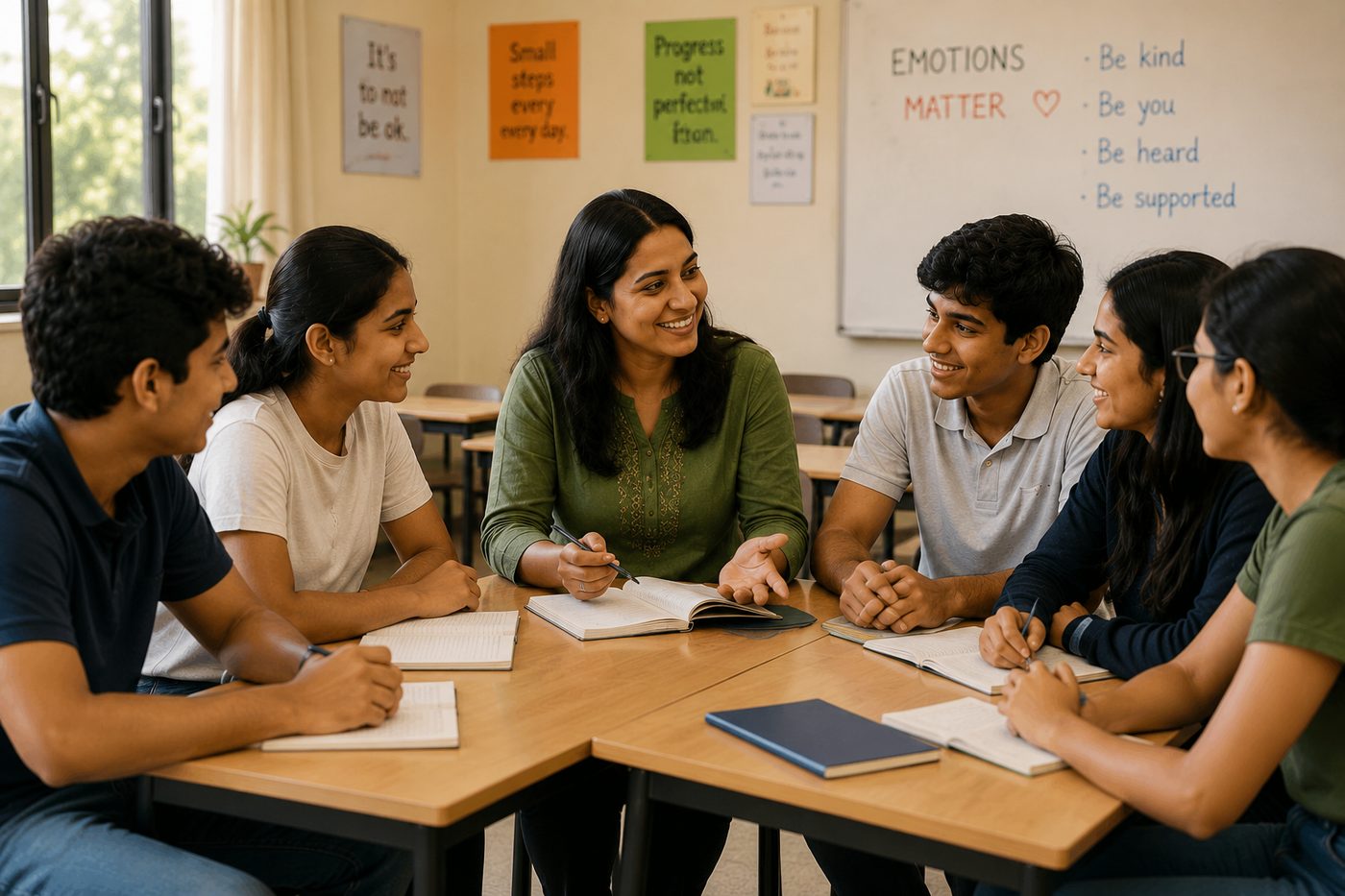
A facilitator leading a wellbeing discussion with students gathered around a table, 'Emotions matter' written on the board
No other institution has as much consistent time with a child as a school.

Walk into almost any classroom and you'll find at least one student who's technically present and nowhere close to actually being there, quiet, not disruptive, not failing, just absent in every way that doesn't show up on a register.

Teachers see this constantly: a kid coasting through a hard year at home, a friendship that fell apart, an anxiety nobody's asked about, and none of it visible in a grade until it's already become a crisis.

Schools are set up to notice when a child falls behind in reading. They're far less equipped to notice when a child is quietly falling apart.

That gap is exactly why emotional wellbeing in schools can't keep being treated as an add-on, something for the guidance counselor's office or a once-a-year assembly. It has to be part of how a school runs, day to day, the same way math or reading is.

Why Schools Are the Right Place for This

Kids spend more waking hours at school than almost anywhere else. Six, seven hours a day, five days a week, for over a decade. No other institution has that much consistent time with a child during the exact years their brain is still learning how to handle stress, disappointment, and relationships. A doctor sees a child for twenty minutes a year, if that. A school sees them grow up.

That's really the argument in one sentence. Schools aren't just a convenient place to fit this in. They're the only place with enough repeated contact to actually teach it, model it, and catch it early when something's going wrong.

Academic Success Was Never the Whole Picture

For a long time, "doing well in school" meant one thing: grades. But a child who's anxious, exhausted, or quietly falling apart doesn't stop being a person with feelings just because they're sitting in a classroom. Academic success and emotional success were never actually separate things, we just built our report cards as if they were.

A child who can't regulate frustration will struggle to sit through a hard math problem. A child who's terrified of being wrong will raise their hand less, participate less, learn less. The two feed each other constantly. Chasing one while ignoring the other doesn't just shortchange a kid's wellbeing, it undercuts the very academic outcomes schools are trying so hard to protect.

The Pressure Kids Are Actually Under

Ask most students what school feels like day to day and "stressful" comes up fast. Grades, exams, college applications, comparison with classmates, a phone that never really lets them switch off from any of it. This isn't new exactly, but it's gotten heavier, and schools have mostly kept responding to it the same way they always have: more content, tighter timelines, higher stakes.

1 in 710–19 year-olds
"Globally, it is estimated that one in seven (14.3%) of 10–19-year-olds experience mental health conditions, yet these remain largely unrecognized and untreated. Adolescents with mental health conditions are particularly vulnerable to social exclusion, discrimination, stigma, educational difficulties, risk-taking behaviours, physical ill-health and human rights violations."
World Health Organization — Adolescent mental health fact sheet

A lot of that struggle is happening quietly. Schools aren't causing all of it. But they're present for almost all of it, which means they're also positioned to catch it.

What SEL Actually Is

SEL, social and emotional learning, isn't some vague wellness buzzword. It's a defined, researched approach, most widely shaped by the Collaborative for Academic, Social, and Emotional Learning, or CASEL, which breaks it down into five teachable areas: self-awareness, self-management, social awareness, relationship skills, and responsible decision-making.

What makes CASEL's framework useful is that none of this is left abstract. Self-management includes something as concrete as knowing how to calm down before reacting. Relationship skills include knowing how to ask for help, or navigate a disagreement without it turning into a shouting match. These are the exact things most of us were never taught directly, and CASEL's research consistently shows they can be, with the same structure and repetition we already use for reading or math.
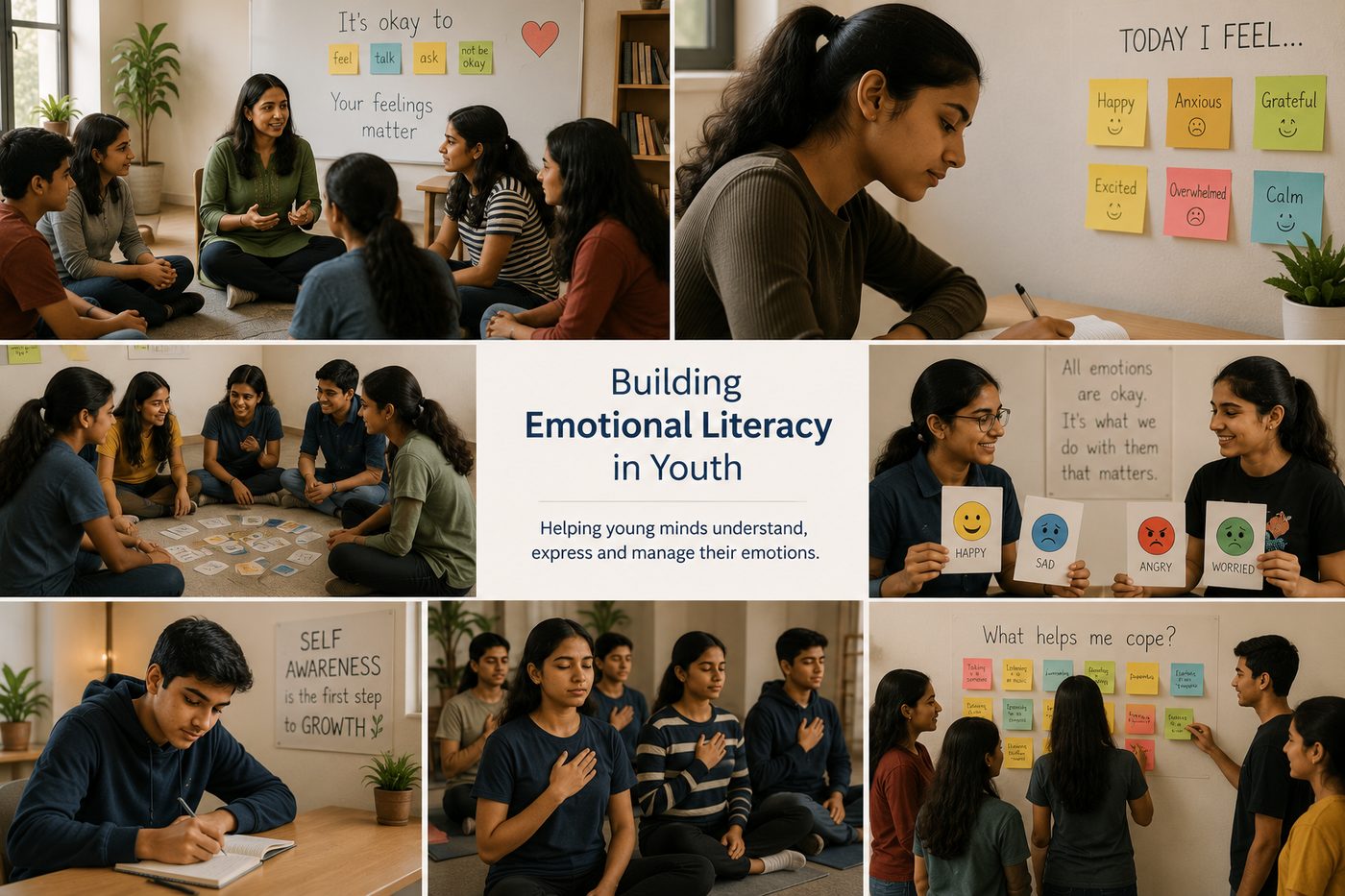
A collage of young people learning to name and express their emotions through group activities, journalling, and reflection
Social and emotional skills can be taught with the same structure we already use for reading or math.

Preventive Mental Health Beats Reactive Mental Health

Most school mental health support kicks in after something has already gone wrong, a crisis, a breakdown, a note home. Good school mental health care flips that order. It's built into the everyday routines of school life, so problems get caught while they're still small.

This is the same logic public health has used for decades with physical illness. You don't wait for an outbreak to teach handwashing. UNICEF's work on school wellbeing makes this point directly, framing emotional support not as crisis response but as a basic part of a school's duty of care, right alongside safety and nutrition. Preventive support costs less, in money and in suffering, than trying to fix a crisis after it's already happened.

What Actually Changes When Schools Do This Well

Schools that build student wellbeing into daily life tend to see it show up in fairly ordinary, measurable ways. Fewer disciplinary incidents. Better attendance. Stronger relationships between students and teachers. Test scores that hold steady or even improve, because a calmer classroom is simply easier to teach in.

A calmer classroom is simply easier to teach in.

None of this needs to be dramatic to work. It can be as simple as a regular check-in built into the school week, or teachers trained to notice early signs of a student struggling, rather than waiting for a crisis to force the issue.

Countries Already Doing This

None of these systems are identical, and none are perfect. But they share the same basic bet: that a school which looks after how its students feel ends up with students who also do better at everything else.

🌏UNESCO's Happy Schools Project

Started in the Asia-Pacific region, it rebuilds a school's culture around three things, its people, its processes, and its physical space, all oriented toward wellbeing rather than treating it as separate from learning. Schools involved report more motivated students and calmer classrooms as stress drops and belonging grows.

🇸🇬Singapore

Has had social and emotional learning built into its national curriculum since 2005, through Character and Citizenship Education, with mental health support and counseling integrated into ordinary school life rather than kept separate from it.

🇧🇹Bhutan

Built its entire education philosophy around Gross National Happiness, training teachers not just in subject content but in compassion and mindfulness, and merging that into how classrooms are actually run.

🇫🇮Finland

Known for strong academic results, treats wellbeing and teacher-student trust as core to how school works, not separate from it. Research on Finland's system suggests academic performance and student wellbeing reinforce each other rather than compete.

🇬🇧United Kingdom

PSHE, the subject that covers emotional health, only became a required part of the curriculum in 2020, a reminder of how recently even wealthy education systems have started treating this as core rather than optional.

The Long Game

The real case for taking this seriously isn't just about a calmer classroom this year. It's about who these kids become. A teenager who's learned how to manage stress, ask for help, and recover from failure carries that into university, into their first job, into every relationship after that. A teenager who never learned any of it carries that too, just in a harder direction, often for decades before they ever get the support they needed at fourteen.

Schools already understand this logic for literacy. Nobody debates whether teaching a child to read will matter later in life. Emotional wellbeing in schools deserves the same certainty, because the cost of skipping it doesn't disappear.

It just shows up later, in a doctor's office, a therapist's office, or a workplace, instead of a classroom where it could have been caught early and gently.

Share wa in @

Bring wellbeing into a school near you

Resilio Foundation partners with schools across Karnataka to build emotional literacy, resilience, and everyday wellbeing into how a school actually runs.

Read More Articles